
Boxing Glove Padding & Mold Types: Understand What Goes Inside Your Gloves
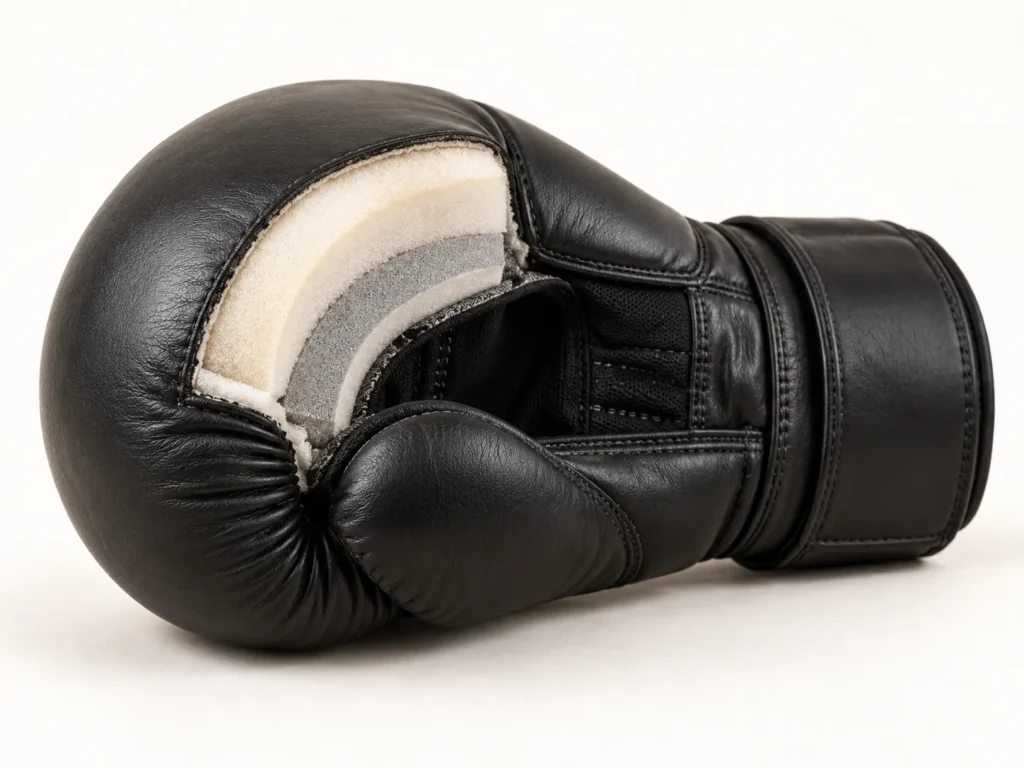
PADDING MATERIALS & MOLD CONSTRUCTION
Boxing Glove Padding & Mold Types: Understand What Goes Inside Your Gloves
The padding inside a boxing glove influences its cushioning, firmness, shape and fist closure. For custom boxing gloves, choosing a foam name or layer count is only the starting point. The materials, their arrangement and the shape of the padding must work together for the intended use.
For private label brands, boxing gyms and wholesale buyers, a clear padding specification helps turn product expectations into a sample that can be properly evaluated.
Padding Material, Layers & Mold: What Is the Difference?
These terms describe different parts of a glove’s construction. Understanding them makes supplier quotations easier to compare.
- Padding material: What the cushioning is made from, such as polyurethane foam, latex foam or EVA.
- Layer construction: How different padding materials and thicknesses are arranged.
- Molding method: How the padding is formed into its shape.
- Padding profile: The finished shape, including knuckle coverage, finger curve and space around the hand.
A glove can combine several materials and construction methods. “Molded” does not automatically mean single-layer, and “multilayer” does not identify the materials inside.
Polyurethane Foam: Available in Different Formulations
Polyurethane, often abbreviated to PU, is used in boxing glove padding, including molded constructions. Here, PU refers to the cushioning inside the glove—not the synthetic leather covering outside.
- Role in construction: Can form a shaped padding core or a cushioning layer.
- What can vary: Density, firmness, thickness and recovery characteristics.
- What buyers should request: The foam grade and intended function within the padding system.
- What to evaluate: Consistency between samples, comfortable fist closure and performance after repeated compression.
Density and firmness are different properties. Density measures mass per unit volume; firmness describes resistance to compression. A higher-density PU foam can still feel soft.
Latex Foam: Used in Layered Padding Systems
Latex foam appears in boxing glove constructions, including some bag-and-pad models with layered latex padding. Its suitability depends on the formulation, thickness and complete padding design.
- Role in construction: A cushioning component within a single-material or mixed-material padding system.
- What to specify: Foam grade, layer thickness, firmness and placement.
- What to evaluate: How the assembled padding compresses and recovers, and how easily the glove closes.
- Buying consideration: “Latex padding” alone does not establish whether a glove is suitable for sparring.
EVA Foam: A Component in Selected Padding Combinations
Ethylene-vinyl acetate, or EVA, is used in some boxing gloves alongside other foams. For example, certain constructions combine an EVA layer with a separate foam core.
- Role in construction: Can contribute structure and firmness within the padding assembly.
- What to specify: Grade, thickness, firmness and position within the glove.
- What to evaluate: Whether the completed glove has the intended cushioning and flexibility.
- Buying consideration: EVA is one component of the design; its presence alone does not establish overall impact performance.
Gel Inserts: An Addition to a Foam System
Some boxing gloves use gel layers or inserts alongside a foam core. Gel is an additional component, rather than a complete description of the padding construction.
- Ask where it sits: Confirm its location and coverage.
- Ask what supports it: Identify the surrounding foam materials.
- Check the finished result: Evaluate weight distribution, flexibility and fit.
- Compare evidence: A “gel” label alone does not demonstrate better cushioning than another construction.
Horsehair & Foam Combinations: A Specialized Construction
Horsehair appears in traditional fight-glove constructions and in selected combinations with foam. It is a fibrous filling, so it should be identified separately from the foam layers.
- What to clarify: Whether the padding uses horsehair, foam or a combination.
- What to inspect: Filling distribution, containment and consistency.
- What to define: The exact intended use of the finished model.
- Buying consideration: Do not assume that a fight-style padding system is suitable for everyday sparring.
Injection-Molded Foam: Padding Formed in a Shaped Mold
Injection-molded foam, commonly described as IMF, is produced by introducing a foam-forming formulation into a shaped mold. This creates a preformed padding component with a defined contour.
- Why consider it: A defined core shape provides a useful starting point for repeatable production.
- What to specify: Material formulation, core dimensions, knuckle thickness and finger curvature.
- What to inspect: Uniform shape, unwanted voids, hard spots and left-to-right consistency.
- What to ask: Whether the molded core is used alone or combined with additional layers.
IMF is not automatically a bag-only or sparring-only construction. Manufacturers offer injection-molded models for both uses, with different product specifications.
Hand-Layered Padding: Separate Foam Layers Built into a Profile
Hand-layered padding combines cut pieces of foam into a shaped assembly. Suppliers may call this a “handmade mold” or “hand-molded padding,” so ask them to explain the actual construction behind the wording.
- Why consider it: Individual materials and thicknesses can be selected for different parts of the assembly.
- What to specify: Each layer’s material, thickness, position and attachment method.
- What to inspect: Smooth transitions, consistent coverage and secure layer placement.
- What to ask: How the supplier controls thickness and shape across a production batch.
Three, four or five layers are descriptions—not quality grades. Compare what each layer does and how the complete glove performs.
Mold Shape & Hand Fit: Look Beyond the Outside Appearance
The padding profile helps determine where the knuckles sit and how the fingers curl. A glove can look compact outside yet feel restrictive inside, so review the finished sample with hand wraps.
- Knuckle coverage: Check that the intended striking area is properly covered.
- Finger curve: Assess whether the fingers can curl without uncomfortable resistance.
- Hand compartment: Check width and depth with the intended wrap setup.
- Padding transitions: Feel for abrupt ridges or uncomfortable edges.
- Pair consistency: Compare both gloves for shape and closure feel.
For OEM development, clarify whether your design uses an existing padding profile, an adjusted layered pattern or new tooling. Request any associated development cost and sample timeline before proceeding.
Match the Padding Specification to the Intended Use
Start with the training application, then assess the complete glove. The following points are a practical brief for sample development.
| Intended use | Development priorities | What to confirm |
|---|---|---|
| Bag and pad work | Repeated-impact performance, secure fit and comfortable fist closure | The model is designed and evaluated for this use |
| Sparring | Appropriate contact cushioning, consistent coverage and fit | The model is intended for sparring and accepted by the buyer’s gym |
| General training | A clearly defined set of activities | Whether the design includes sparring or is limited to bags and pads |
| Competition | A specification suited to the intended event | Applicable approval and equipment requirements before production |
Dedicated bag gloves can have hard padding that is unsuitable for sparring. Glove weight or a “training” label should not replace a clear intended-use specification.
What to Check Before Approving Bulk Production
Use sample inspection to assess workmanship and fit, alongside appropriate performance testing. A hand-squeeze check alone cannot establish impact protection.
- Written padding breakdown: Record materials, layer order, thicknesses and molded components.
- Coverage and consistency: Check for thin areas, lumps, gaps or differences between gloves.
- Fit with wraps: Assess finger space, knuckle position and fist closure.
- Recovery and durability: Request relevant compression-set and fatigue information. Compression set measures lasting thickness loss after compression.
- Finished-glove evaluation: Discuss testing appropriate to the intended use, including performance after repeated loading.
- Approved reference sample: Keep the agreed sample and specification as the production reference.
Discuss Padding Options for Your Private Label Boxing Gloves
Tell Hexa Gears your intended use, target customer, preferred glove feel and order requirements. Share a reference sample or construction brief to discuss available padding materials and mold options for your collection.